

Montessori cycle for ages 3–6: essential progression in three stages
In a Montessori classroom, children aged 3 to 6 learn together in the same environment, each progressing at their own pace through a three-year cycle that cannot be separated.
This environment promotes confidence, concentration, and independence—fundamental skills for all future learning.

First year: discovery and exploration (3–4 years old)
Three-year-olds enter a rich, orderly world that has been carefully prepared for them. They observe, experiment, touch, pour, sort, tidy up, and repeat with enthusiasm. Through practical life materials, they learn to pour water, button, lace, use a pipette, clean a table, and even prepare a snack. These activities help them strengthen their fine motor skills and hand-eye coordination, as well as their independence and sense of order.
At the same time, sensory materials broaden their relationship with the world: they manipulate the pink tower, red rods, sound boxes, and color tablets. Thanks to these tools, they develop their ability to distinguish between sizes, shapes, sounds, and nuances, gradually building logical and organized thinking.
This is also the year when children discover the joy of learning on their own, settle down for longer periods of activity, and begin to build the foundations of concentration and self-confidence. Early language exercises (vocabulary cards, rough letters, picture stories) and the beginnings of mathematics (number bars, quantity games) feed his natural curiosity and help him structure his thinking.
This first year of Montessori is a crucial time: it is when children open up to the world with enthusiasm, develop precise movements, and discover their own abilities with pride.
Second year: consolidation and understanding (4–5 years old)
Building on their experience and year of exploration, children aged 4 to 5 enter a phase of consolidation. They have now mastered many everyday skills and use Montessori materials with ease. This familiarity allows them to go further: they understand the links between activities, anticipate steps, and begin to think in a more structured way.
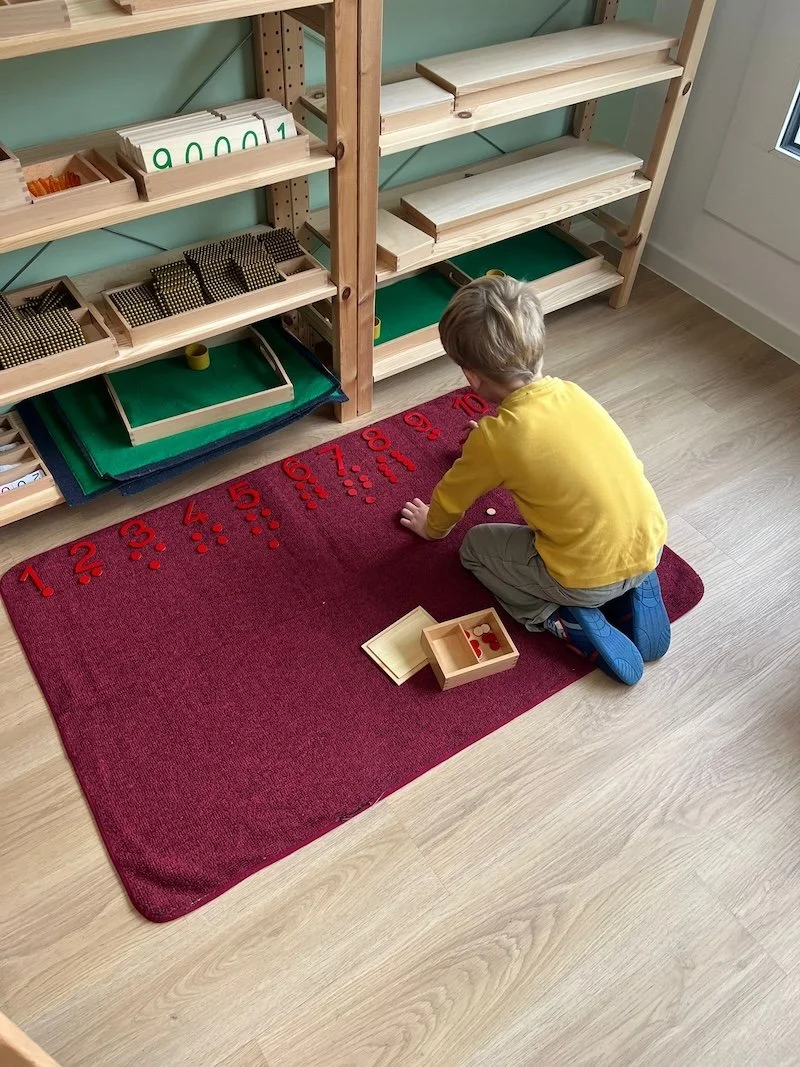
The materials gradually lead him towards abstraction. In language, he explores sounds, associates rough letters with phonemes, composes his first words with the movable alphabet, and sometimes begins to read small phonetic words. In mathematics, he manipulates red and blue rods, spindles, rough numbers, and then golden beads, discovering in a concrete way the concepts of quantity, numeration, and simple operations.
Through logical activities—sorting, classifying, sequencing, and associating—he also develops his ability to organize his thoughts and understand the relationships between objects.
This is a period of intellectual growth: children become more precise and curious, and develop the ability to carry out longer and more complex tasks. They assert themselves, deepen their existing knowledge, and gently prepare for more abstract learning.
Third year: completion and transmission (5–6 years old)
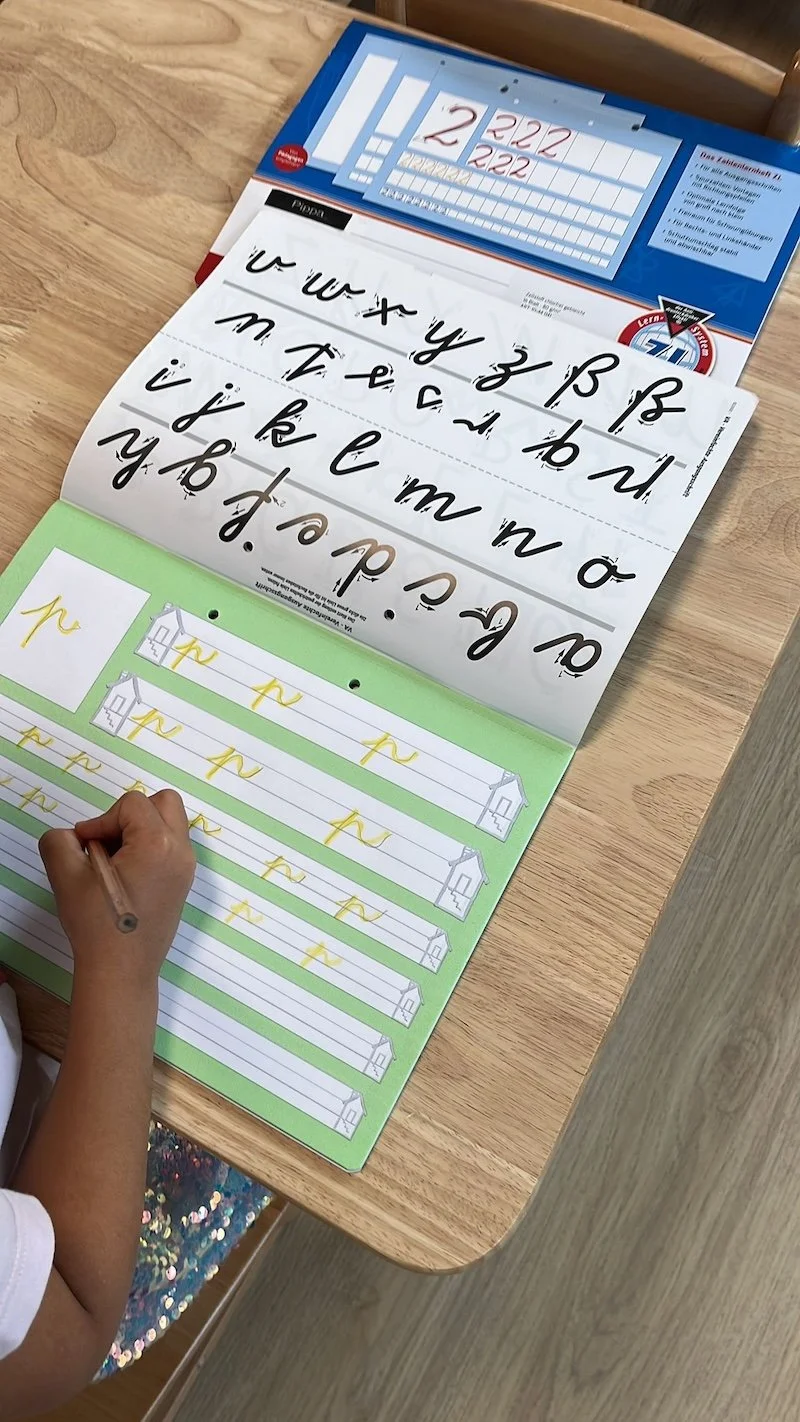
The final year of the Montessori cycle is a key stage, when the child becomes the "big kid" in the class. With two years of experience and exploration behind them, they consolidate everything they have learned and gradually put it into practice to become more independent. They read short stories, write sentences fluently using the movable alphabet and silent dictations, and use beads to perform addition, subtraction, and even simple multiplication. Abstract concepts take on their full meaning because they are based on years of concrete manipulation.
This increase in skill comes with a new role: that of a guide for younger children. The child shows them how to roll up a mat, tidy away equipment, trace a letter, or take care of the environment. This natural transfer of knowledge boosts their confidence, sense of responsibility, and feeling of belonging to the group.
They now express themselves with ease, know how to reason, explain their work, solve small problems, and see a long activity through to completion. This is a year of maturity, balance, and leadership, when children fully assert themselves.
At the end of this third year, they have the intellectual, emotional, and social foundations that ideally prepare them for entry into elementary school.
Why do the three years?
Each year of the cycle plays a complementary and essential role.
Learning progresses in a gradual and logical manner: what children explore in concrete terms in the first year, they understand and integrate in the second, then master and pass on in the third. It is this continuity that gives Montessori education its power.
The Montessori approach is based on repetition, freedom of choice in work, and the self-confidence that children develop over time. These qualities are not built in a few months, but thanks to the stability of the group, the consistency of the educators, and the length of the cycle.
It is in the third year that children fully reveal the fruits of their efforts: they become independent, precise, capable of helping younger children, and feel a real sense of pride in having grown up in this environment.
So, doing just one year is like opening a door without having time to walk through it. The real benefit of Montessori education becomes apparent over time: it is a three-year program designed to support the child's overall development, from discovery to mastery, in an atmosphere of trust and joy of learning.